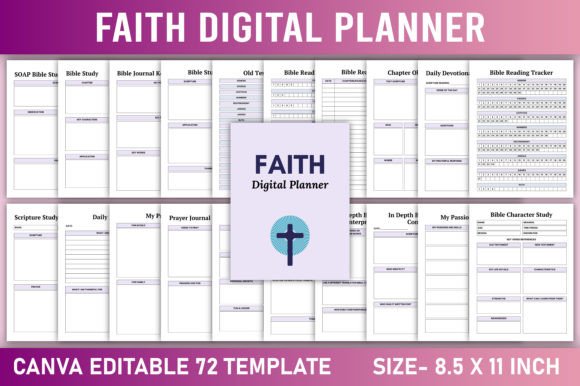
Editable Faith Digital Planner Canva: A Flexible, Print-Ready Tool for Intentional Spiritual Growth
At the intersection of digital convenience and devotional discipline lies the Editable Faith Digital Planner Canva — a thoughtfully structured, fully customizable resource designed not just for tracking Bible reading or prayers, but for cultivating consistent, reflective, and personally resonant spiritual practice. Unlike static PDF planners or generic digital notebooks, this planner bridges intentionality with adaptability: it arrives as a professional-grade KDP interior file (PDF) *and* includes a live Canva editing link — meaning users retain full creative control over layout, tone, and visual language without needing design expertise.
Why Editability Matters in Spiritual Tools
Spiritual rhythms shift across seasons — a new parent may need shorter devotionals; a seminary student might prioritize deep exegetical space; a small-group leader could require printable sermon note templates. A one-size-fits-all planner quickly becomes obsolete when life changes. The Editable Faith Digital Planner Canva anticipates this reality. Because every element — from font pairings and color palettes to section headers and background textures — is editable in Canva, users aren’t confined by preset aesthetics. They can soften pastel tones for gentle morning reflection, switch to high-contrast typography for accessibility, or embed personal scripture graphics into the Bible Reading Log or Chapter Summaries pages.
This level of ownership transforms passive consumption into active participation. When someone adjusts the Daily Prayer layout to include space for breath prayers or adds icons beside Prayers For Others, they’re not just filling blanks — they’re shaping theology-in-practice. That’s why educators use it to scaffold faith-based journaling for youth groups, therapists integrate Devotional Reflection prompts into Christian counseling workflows, and entrepreneurs anchor daily planning with My Yearly Goals alongside Yearly Bible Goals.
Structure Designed for Depth, Not Just Tracking
The planner’s architecture reflects theological literacy and practical psychology. It avoids superficial checklists in favor of layered engagement. Consider the SOAP Bible Study framework — Scripture, Observation, Application, Prayer — which appears not as a single template but as three distinct page variations. One version guides beginners with sentence starters (“I notice…”, “This reminds me of…”); another offers blank margins for marginalia and cross-references; a third integrates space for Hebrew/Greek word studies. Similarly, the Bible Character Study page doesn’t ask “What did David do?” but invites analysis of narrative context, cultural backdrop, theological tension, and personal resonance.
Even functional tools carry theological weight. The Bible Reading Tracker (8 Page) isn’t merely a grid — it maps canonical flow while allowing customization for thematic plans (e.g., “Wisdom Literature First” or “Chronological New Testament”). The Old Testament and New Testament sections include built-in reference keys linking chapters to covenant themes, helping readers see continuity rather than fragmentation. Meanwhile, the Chapter Observations and Chapter Summaries pages encourage slow reading — prompting users to identify repeated words, literary devices, and emotional arcs before rushing to application.
From Personal Practice to Shared Ministry
While many digital planners serve solo users, this resource scales meaningfully into communal and professional settings. Church staff download the PDF to produce print-on-demand copies for new members, then use the Canva link to brand pages with their logo, sermon series colors, or pastoral notes. Homeschool families duplicate the Daily Devotional spread across multiple children’s planners — each with age-appropriate vocabulary in the Scripture Study section. Small-group facilitators customize the Sermon Notes page to align with their church’s teaching rhythm — adding space for “One Takeaway,” “One Question,” and “One Action Step.”
For creators and educators, the dual-format delivery unlocks unique workflows. A theology professor might extract the Bible Journal Key and Bible Study Notes pages to build a custom syllabus supplement. A content creator building a faith-based YouTube channel can reformat the Gratitude Tracker into an Instagram carousel template — preserving the original structure while adapting visuals for social sharing. And because the KDP interior is print-ready (CMYK-optimized, bleed-safe, 300 DPI), those same files go straight to Amazon KDP without redesign or conversion delays.
Customization Without Compromise: What You Control
The Canva editing link grants granular control — but crucially, it preserves structural integrity. Users can:
- Recolor entire sections — change the hue of the Morning Gratitude header to match seasonal liturgical colors (Advent purple, Easter gold)
- Swap fonts — replace serif headings with handwritten-style type for the My Prayers section to evoke intimacy
- Resize and reposition elements — expand the Answered Prayer log to accommodate longer testimonies or condense the Blessings tracker for quick nightly review
- Add imagery — insert nature photos into Daily Devotional backgrounds or overlay subtle watermarks of favorite verses onto Prayer Request pages
- Modify layouts — convert two-column Prayer Notes into a single-column format for larger handwriting or screen-reader compatibility
None of these edits break functionality. The Bible Reading Plan remains logically sequenced even if fonts change; the Prayer Journal 2 Unique Page retains its dual-perspective design (self/others) regardless of background texture. This balance — between freedom and fidelity — is what distinguishes the Editable Faith Digital Planner Canva from DIY templates that sacrifice coherence for flexibility.
Real-World Use Cases Across Diverse Contexts
A hospice chaplain uses the Prayers For Myself and Prayers For Others pages to document intercessions during home visits — later exporting clean PDFs for patient families. A freelance graphic designer working with faith-based clients keeps a branded version of the Belongs To page ready to drop into client proposals as a visual covenant statement. A college campus minister prints the Daily Prayer and Evening gratitude spreads as tear-out handouts for retreats, knowing students can later personalize them digitally.
Notably, the planner accommodates both high-intensity and low-pressure engagement. The 10 Minute... section (intentionally open-ended) supports micro-practices: “10 Minute Scripture Meditation,” “10 Minute Praise Break,” or “10 Minute Listening Prayer.” This design honors time scarcity without diluting spiritual substance — a critical consideration for professionals balancing ministry, family, and vocation.
Technical Readiness Meets Human-Centered Design
Every page is optimized for multiple outputs. The PDF meets KDP specifications: standard 6"x9" trim size, proper margins, embedded fonts, and CMYK color profiles. Yet the underlying Canva structure uses responsive grids and non-destructive layers — meaning edits don’t pixelate or misalign when exported. Backgrounds are vector-based where possible; text boxes use paragraph styles for global updates; and placeholder images are labeled clearly for replacement.
This technical rigor serves human needs. A visually impaired user can increase font size across all Prayer List entries without breaking the layout. A non-native English speaker can translate headers in Canva while retaining the original page logic. A business owner running a Christian bookstore can white-label the SOAP Bible Study pages with their store’s branding and sell printed versions locally — all from the same source file.
Integrating Faith, Function, and Flexibility
In an era where digital tools often prioritize speed over soulfulness, the Editable Faith Digital Planner Canva stands apart by refusing false binaries: it is simultaneously structured and open, printable and editable, theologically grounded and personally adaptable. Its 50+ pages — from Praise and Thanksgiving logs to My Prayer List and Scripture Study — form not a rigid system, but a living framework. Each component invites engagement at the user’s current capacity: whether that means filling one line in the Daily Gratitude box or spending an hour expanding the Bible Character Study of Ruth.
Ultimately, this isn’t just a planner you download and use. It’s a tool you inhabit, refine, and pass on — reshaped by your voice, your season, your calling. Whether you’re preparing a sermon, mentoring a teen, launching a nonprofit, or simply learning to pray again, the Editable Faith Digital Planner Canva meets you where you are — and gives you the means to grow from there.