Why the 2024–2025 Self-Care Workbook for Canva Is Reshaping How Creators Approach Digital Planners
Planners aren’t just about checking off tasks anymore—they’re tools for emotional resilience, intentional living, and creative sustainability. That’s why the 2024–2025 Self-Care Workbook for Canva stands out in a crowded marketplace: it doesn’t ask you to choose between productivity and presence. Instead, it merges both—thoughtfully, beautifully, and with real flexibility.
A Template Designed for Real Life—Not Just Aesthetic Pins
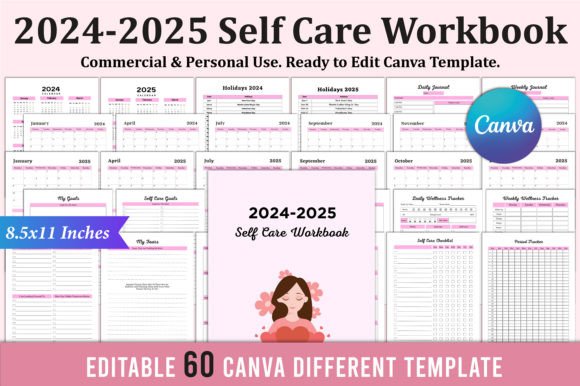
Scroll through most planner listings, and you’ll see beautiful layouts—but few deliver consistent, layered support across mental, physical, and emotional wellness. This workbook does. With 60 distinct Canva templates, each page serves a specific purpose—not filler. The 2024–2025 Calendar isn’t just dates; it’s anchored by 2024–2025 Holidays, helping users plan rest *around* cultural and personal rhythms—not against them. The Daily Journal includes space for quick wins *and* gentle reflection—not just “what I did,” but “how I felt while doing it.”
That intentionality carries through every section: the Routine Tracker helps build consistency without rigidity; the This Makes Me Happy / This Makes Me Unhappy spreads encourage emotional literacy—not judgment; and the Reframe Your Thoughts page gives users immediate, actionable language to shift perspective during stress. It’s psychology-informed design, not just pretty pages.
Why Canva Editing Changes Everything—for Sellers and Users Alike
This isn’t a static PDF you print and hope fits your life. It’s an editable Canva template—meaning color palettes, fonts, headers, even layout spacing can be adjusted in minutes. For creators selling on KDP or Etsy, that’s transformative. You’re not locked into one version—you can tailor the interior to match seasonal themes, audience niches (e.g., students, therapists, new parents), or brand guidelines—all without redesigning from scratch.
For end users? It means ownership. No more struggling to fit your name, pronouns, or preferred wellness metrics into someone else’s rigid format. Want to swap “Period Tracker” for “Hormone Symptom Log”? Done. Prefer “30 Days of Gratitude” over “30 Days Challenge”? Swap it. The 2024–2025 Self-Care Workbook for Canva respects how dynamic self-care actually is—and builds in room for evolution.
What Makes the KDP Interior Stand Out for Print-on-Demand Sellers
If you're building a planner business on Amazon KDP, interior quality directly impacts reviews, returns, and long-term visibility. This workbook delivers what seasoned sellers prioritize:
- 8.5 x 11 inches—the standard US letter size, optimized for home printers and KDP compatibility;
- 300 DPI resolution—ensuring crisp text and clean lines, even in grayscale printing;
- CMYK color mode—critical for accurate color reproduction in professional print runs;
- No bleed—eliminating risky edge-cropping and simplifying KDP upload workflows;
- 100% original design—no stock art, no recycled layouts, no copyright red flags.
Plus, the inclusion of a ready-to-use Editable Canva Link means you’re not wrestling with layers in Photoshop or Illustrator. You paste, personalize, export—and move on to marketing, not troubleshooting.
More Than Pages: A System Built Around Human Rhythms
Look closely at the structure, and you’ll notice something subtle but powerful: the workbook mirrors how people actually experience time and energy. It’s not just monthly grids—it’s Weekly Wellness Tracker (2-page spread), giving space to assess energy dips and peaks across seven days—not just productivity. It’s Sleep Tracker paired with Daily Wellness Tracker, acknowledging that rest isn’t passive—it’s data worth honoring.
The Dear Future Self and My Fears pages aren’t journaling gimmicks. They’re invitations to practice vulnerability safely—something especially valuable for teens, caregivers, or anyone rebuilding after burnout. And the Bucket List isn’t buried at the back. It’s positioned early—because clarity about joy and longing often comes *before* goals, not after.
Real-World Use Cases—Beyond the Screen
Here’s where this workbook proves its versatility:
- Therapists & Coaches: Print select pages (e.g., Reframe Your Thoughts, Gratitude Journal) as session handouts—fully branded and editable to match practice values.
- College Students: Combine the To Do List, Weekly Journal, and 30 Days Challenge to manage academic load while protecting mental bandwidth.
- New Parents: Use the Period Tracker alongside Sleep Tracker and Routine Tracker to spot patterns—not just log exhaustion.
- KDP Sellers: Bundle the 2024–2025 Self-Care Workbook for Canva with themed covers (e.g., “Mindful Mom Edition,” “Anxiety Relief Planner”)—same interior, fresh positioning.
Design Integrity Meets Practical Flexibility
You’ll find no visual clutter here. Every icon is custom-drawn. Every font pairing supports readability—not trend-chasing. The Daily Gratitude section uses ample white space—not to look minimalist, but to reduce cognitive load when emotions run thin. The Self Care Checklist avoids vague prompts like “be kind to yourself”—instead offering concrete, adjustable actions: “I paused before replying to that text,” “I turned off notifications for 90 minutes,” “I said no without explanation.”
And because it’s built for Canva, updates are frictionless. Spot a typo? Fix it in seconds. Want to add a “Hydration Log” for summer launches? Duplicate a tracker page and re-label. No designer dependency. No version control chaos.
What Buyers Actually Look For—And Why This Delivers
When shoppers search for “self-care planner printable” or “Canva editable planner 2025,” they’re rarely hunting for novelty. They want trust. Trust that the template won’t crash Canva. Trust that pages print correctly. Trust that content feels relevant—not generic. That’s why specifications matter: CMYK color, no bleed, and 300 DPI aren’t technical jargon—they’re quiet promises of reliability.
They also want resonance. The inclusion of Favorite Quotes and Notes pages signals permission—to borrow wisdom, to scribble messy ideas, to leave blank space for what hasn’t formed yet. That’s not fluff. It’s scaffolding for growth.
Finally, they want longevity. A 2024–2025 date range isn’t arbitrary—it’s strategic. It spans two calendar years, accommodating planners who start mid-cycle (say, March 2024) and continue through December 2025. No wasted pages. No rushed transitions.
Your Next Step Isn’t Just Planning—It’s Prioritizing
The 2024–2025 Self-Care Workbook for Canva doesn’t promise perfection. It offers something more useful: structure that adapts, beauty that breathes, and depth that stays grounded in daily reality. Whether you're designing for others or choosing for yourself, it meets you where you are—not where algorithms think you should be.
It’s ready when you are: open the Canva link, adjust one color, add your name, and begin—not with pressure, but with possibility.