Tracing Worksheets Alphabet and Numbers: A Practical, Print-Ready Resource for Educators and Creators
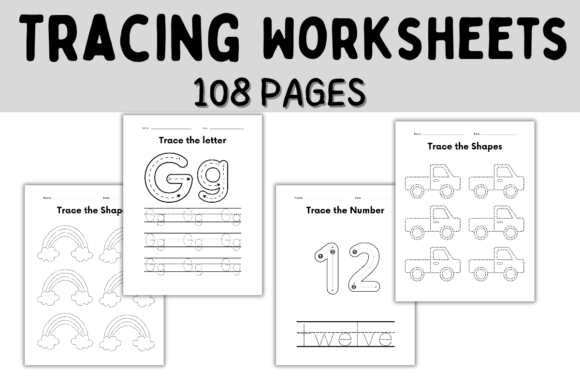
Tracing Worksheets Alphabet and Numbers isn’t just another printable pack—it’s a thoughtfully structured, classroom-tested toolkit designed to support early learning development while fitting seamlessly into modern teaching and publishing workflows. With 108 pages of high-resolution (300 DPI), letter-size (8.5×11″) PDFs—covering tracing lines, shapes, uppercase and lowercase letters, and numbers 0–9—the collection delivers consistency, clarity, and flexibility in one downloadable .zip file. Whether you’re preparing hands-on materials for preschoolers, building a KDP interior for a tracing workbook, or assembling differentiated resources for inclusive instruction, this set bridges pedagogical intention with practical execution.
Why Tracing Still Matters—Even in a Digital Age
At first glance, tracing might seem like a relic of pre-tablet classrooms. But research and classroom observation tell a different story: fine motor development, visual-motor integration, and early symbol recognition remain foundational—and they don’t happen reliably through screen time alone. Children aged 3–6 learn best when movement, sight, and repetition align. Tracing lines builds hand strength and directional control; tracing shapes introduces spatial reasoning; tracing alphabet and numbers links symbol form to meaning long before independent writing begins. What’s changed isn’t the need for tracing—it’s how and where it fits into broader learning ecosystems.
Today’s educators aren’t choosing between digital tools and paper-based practice—they’re layering them. A kindergarten teacher might use an interactive whiteboard for letter formation modeling, then follow up with printed Tracing Worksheets Alphabet and Numbers for tactile reinforcement. A homeschool parent may print select pages weekly, bind them into a spiral notebook, and track progress over time. And creators launching on Amazon KDP appreciate that these worksheets are formatted precisely for interior use—no resizing, no pixelation, no layout surprises.
Designed for Real Workflows—Not Just Idealized Ones
The 108-page structure reflects real-world usage patterns. It begins with simple horizontal, vertical, and diagonal lines—building confidence before introducing curves and closed shapes like circles and squares. From there, it progresses logically: uppercase letters (with consistent stroke direction cues), lowercase letters (grouped by formation families—e.g., “c,” “a,” “d” share similar starting points), and numbers arranged by complexity (0–5 before 6–9). Each page uses clean, uncluttered design—no distracting clipart, no competing fonts—so attention stays on the task.
This intentional sequencing matters because it reduces cognitive load for young learners *and* decision fatigue for adults. A busy preschool teacher doesn’t need to hunt across five websites for separate line-tracing and number-tracing sets. A freelance curriculum designer doesn’t need to adjust margins or resolution before importing into InDesign. Everything is ready: print-ready PDFs, optimized for both home printers and commercial presses, all at 300 DPI—meeting KDP’s interior requirements without extra prep.
How Educators and Creators Are Using These Worksheets Today
In early childhood settings, these pages serve multiple roles beyond handwriting practice. Teachers laminate select sheets and use dry-erase markers for repeated use during center rotations. Others cut out individual letters or numbers and turn them into matching games or sensory bins (pairing traced “S” with sand, “B” with beans). Some pair tracing with oral language: “Say the sound as you trace ‘M’”—blending phonics and motor memory.
For creators building digital products, the versatility expands further. One educator bundled select tracing pages into a “Back-to-School Readiness Kit” sold as a low-cost PDF download alongside video tutorials on pencil grip and posture. Another used the shape-tracing pages as base templates—adding subtle watercolor textures and licensing them as editable Canva designs for teachers building custom slide decks. Because the files are vector-based PDFs (not raster images), scaling remains crisp—even when adapted for large-format posters or interactive tablet apps.
Entrepreneurs leveraging Amazon KDP find particular value in the standardized sizing and consistent styling. Rather than stitching together mismatched free printables—or risking copyright issues with unlicensed clipart—this collection offers a cohesive aesthetic from cover to final page. That cohesion translates directly to customer trust: buyers browsing “tracing book” or “preschool worksheets” on Amazon notice professional formatting, clear progression, and age-appropriate spacing—all signals of credibility in a crowded niche.
Meeting Evolving Expectations—Without Overpromising
Parents and caregivers today expect more than busywork. They want transparency about *why* an activity matters and evidence it aligns with developmental milestones. Tracing Worksheets Alphabet and Numbers supports that shift—not through marketing claims, but through observable design choices. For example, the number pages emphasize formation consistency (e.g., “4” starts with a downward stroke, not a triangle), reflecting current handwriting guidance from occupational therapists. Letter pages include dotted guidelines with dashed midlines—supporting proper proportion awareness long before cursive instruction begins.
Similarly, the inclusion of shape tracing responds to growing emphasis on STEM readiness in early education. Recognizing and reproducing basic shapes isn’t just art—it’s geometry groundwork, pattern recognition, and vocabulary development (“Which shape has three sides?”). When paired with verbal prompts or sorting activities, these pages become springboards—not endpoints.
Practical Tips for Getting the Most Out of This Resource
- Start small. Introduce one category per week—e.g., focus on lines and curves for three days before adding circles. Observe how students hold pencils and adjust grip before moving to letters.
- Use multisensory extensions. Trace letters in shaving cream on trays, form numbers with pipe cleaners, or walk along taped letter shapes on the floor. The worksheets provide the model; your environment provides the variation.
- Leverage the PDF flexibility. Print only what you need—or extract specific pages (e.g., just the “o,” “q,” “g” group) for targeted review. Use Adobe Acrobat’s “Organize Pages” tool to reorder or delete duplicates.
- Track progress meaningfully. Keep dated samples of the same letter over time. Note improvements in pressure control, line smoothness, or letter orientation—not just “got it right.”
- Respect neurodiversity. Some children benefit from heavier tracing lines or raised-line overlays. These PDFs can be imported into accessibility tools or printed on textured paper for added tactile input.
A Resource That Grows With Its Users
What makes Tracing Worksheets Alphabet and Numbers durable—not just trendy—is its refusal to chase novelty at the expense of utility. There are no gimmicks, no forced themes, no seasonal distractions. Instead, there’s clarity of purpose, fidelity to developmental science, and respect for the time constraints educators and creators face daily. As classrooms adopt more blended learning models and self-publishing lowers barriers to entry for educational content, demand is rising—not for more resources, but for better-structured, production-ready ones.
This collection meets that need quietly but effectively. It doesn’t claim to replace teacher judgment or eliminate the need for differentiation. It simply removes friction: between intention and implementation, between idea and printed page, between classroom need and market-ready product. Whether you’re guiding a child’s first pencil stroke or designing your tenth KDP workbook, that kind of reliability is rare—and increasingly valuable.