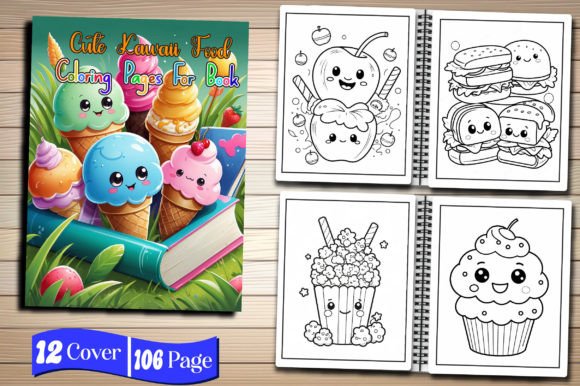
Cute Kawaii Food Coloring Page
A Cute Kawaii Food Coloring Page isn’t just a collection of whimsical donuts, smiling sushi rolls, or blushing cupcakes—it’s a strategically flexible creative asset with measurable utility across multiple business functions. For creators building high-content KDP books, educators designing low-prep classroom tools, or small business owners developing branded activity kits, this type of interior content delivers more than visual charm. It delivers structure, scalability, and audience alignment—when selected and deployed with intention.
Why This Interior Works Beyond Aesthetic Appeal
The strength of a Cute Kawaii Food Coloring Page lies in its dual resonance: it satisfies children’s developmental need for joyful, low-stakes creative expression while simultaneously appealing to adult buyers’ desire for polished, print-ready, and commercially viable assets. Unlike generic clipart or overused public-domain illustrations, kawaii-style food designs carry built-in emotional warmth, cultural recognition (especially among Gen Z and millennial parents), and strong visual consistency—making them ideal for cohesive book branding.
Each page is sized at 8.5″ × 11″ and delivered at 300 DPI in JPG, PNG, and PDF formats—meaning no post-processing is required before uploading to KDP. That eliminates friction in production timelines and reduces the risk of formatting errors that delay launch or trigger Amazon rejections. More importantly, the absence of repeated images ensures your book stands out in search results and maintains perceived value across all 40–60 pages—a critical factor in reducing customer returns and negative reviews tied to “seen-it-before” fatigue.
Strategic Use Cases Across Business Functions
How you apply a Cute Kawaii Food Coloring Page depends less on what it is and more on what outcome you’re optimizing for. Below are three high-leverage applications grounded in real-world creator workflows:
- Product Differentiation in Competitive Niches: In the oversaturated “coloring book for kids” category, thematic specificity matters. “Kawaii food” narrows focus without narrowing appeal—it’s niche enough to rank for long-tail terms like “kawaii cupcake coloring pages” or “Japanese-style food coloring book,” yet broad enough to attract fans of anime aesthetics, baking enthusiasts, and ESL teachers using food vocabulary visuals.
- Brand Extension for Educators & Content Creators: A homeschooling blogger can bundle these pages into a printable “Food Vocabulary Pack” for early learners; a nutrition educator might pair them with simple facts (“Did you know? Avocados have healthy fats!”) to build cross-curricular engagement. The high-resolution files support clean integration into Canva templates, Google Slides lessons, or printed flashcards—extending reach beyond Amazon alone.
- Operational Efficiency for High-Content Publishers: Because each file is print-ready and pre-formatted, creators avoid spending hours resizing, adjusting contrast, or troubleshooting bleed margins. That time savings compounds: one hour saved per book translates to ~20+ additional titles annually for a solo publisher running 20-book launches per year. Consistency in resolution, sizing, and style also means fewer customer service inquiries about blurry prints or cropped edges.
What to Consider Before You Build Around It
Not every Cute Kawaii Food Coloring Page set serves every goal—and assuming otherwise leads to misaligned outcomes. Before committing to a design package, ask yourself:
- Does the visual tone match your existing brand voice? If your other titles use minimalist line art or nature themes, sudden kawaii exuberance may confuse returning customers unless intentionally framed as a new sub-series (“Fun With Food: A Kawaii Spin”).
- Are your target buyers searching for this specific intersection? Run quick keyword checks using tools like Publisher Rocket or Helium 10. Phrases like “kawaii food coloring book for kids” currently show moderate search volume (~1,000–2,500/mo) and relatively low competition—ideal for testing—but “kawaii bento coloring pages” may be too narrow to sustain sales velocity.
- Do you have complementary assets to increase perceived value? Standalone coloring pages sell—but pairing them with bonus elements (e.g., a matching word search, food-themed tracing practice sheets, or a “design your own bento box” activity) strengthens positioning as a learning tool, not just entertainment.
Risks of Using Without Context or Goals
Deploying a Cute Kawaii Food Coloring Page without strategic framing carries quiet but real risks. First, aesthetic mismatch can dilute brand trust—if your cover promises “calming nature scenes” but interiors deliver hyper-sweet pastel croissants with starry eyes, readers feel misled. Second, relying solely on visual novelty without supporting structure (e.g., no progression in line weight, no educational scaffolding, no variety in composition) leads to shallow engagement. Kids may color two pages and set the book aside; adults may notice repetitive layouts and question quality.
Third, there’s operational risk in assuming “print-ready” means “publish-ready.” While JPG/PNG/PDF files eliminate raster-editing steps, KDP still requires correct bleed setup, proper interior PDF export settings (CMYK vs. RGB), and adherence to spine width calculations based on page count. Skipping those checks—even with perfect source files—can result in rejected uploads or costly physical proof delays.
How to Use It Intentionally—Not Just Conveniently
Intentional use starts with defining the job to be done. Ask: What problem does this solve for my reader—or for my business? If the answer is “fills 50 pages quickly,” that’s convenience—not strategy. If it’s “creates an entry point for food-themed SEL activities (sharing, gratitude, trying new things),” or “supports bilingual vocabulary development through visual association,” or “builds a recognizable sub-brand within my KDP catalog,” then you’ve anchored the asset to purpose.
Practical execution follows from that clarity:
- Plan sequencing deliberately. Begin with simpler food icons (a single smiling apple, a basic donut) and gradually introduce layered compositions (a kawaii picnic scene, a sushi train). This mirrors cognitive load theory—supporting skill-building rather than overwhelming.
- Leverage metadata intentionally. In your KDP backend, use precise backend keywords: “kawaii food coloring pages,” “Japanese candy coloring book,” “cute bakery coloring sheets for kids,” “300 dpi food coloring PDF.” Avoid stuffing; prioritize terms your ideal buyer would actually type when seeking this exact experience.
- Test placement beyond Amazon. These pages perform well as lead magnets (e.g., “Download 5 Free Kawaii Food Coloring Pages” in exchange for email signups), as printable add-ons in Etsy digital shops, or as Instagram Story interactive elements (“Color this kawaii ramen bowl and tag us!”). Diversifying distribution increases lifetime value per asset.
Long-Term Value Beyond the First Book
A well-chosen Cute Kawaii Food Coloring Page set isn’t a one-off interior—it’s a reusable component in a scalable content system. Once you’ve validated demand, you can repurpose individual illustrations across formats: turn a kawaii pizza page into a sticker sheet PDF, adapt the same line art for a “food emotions” social-emotional learning guide, or license simplified versions for school newsletter use. The high-resolution source files give you flexibility to crop, recolor, or layer without degradation—something lower-DPI or flattened assets cannot offer.
More importantly, consistent use of this aesthetic builds audience recognition. Readers who enjoy your first kawaii food book will scan your author page for similar titles—not because they love coloring, but because they trust your ability to deliver a specific kind of joyful, well-executed experience. That trust compounds over time, lowering customer acquisition cost and increasing organic discoverability.
So yes—grab your crayons, markers, or colored pencils. But more crucially, grab your planning calendar, your keyword report, and your brand guidelines. Let the Cute Kawaii Food Coloring Page serve your goals—not the other way around.