Cursive Alphabet Handwriting Practice
Cursive Alphabet Handwriting Practice is a purpose-built set of educational worksheets designed to support foundational cursive writing development in early learners—typically children in grades 1 through 3, though adaptable for older students needing remediation or handwriting reinforcement. Unlike generic tracing sheets or isolated letter drills, this resource integrates visual, motor, and linguistic learning cues into a single, cohesive format. Its value lies not in novelty, but in thoughtful execution: each page focuses on one letter—uppercase and lowercase—with layered supports that align with evidence-informed handwriting instruction principles.
Structure That Supports Skill Acquisition
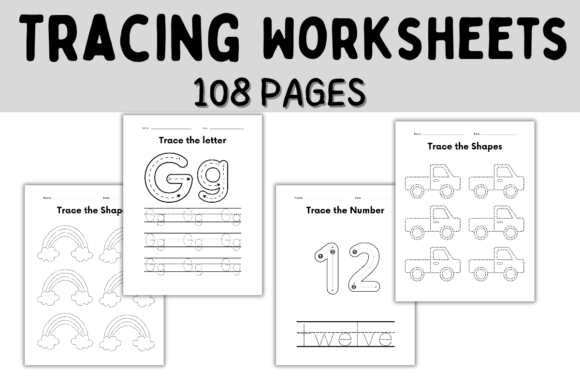
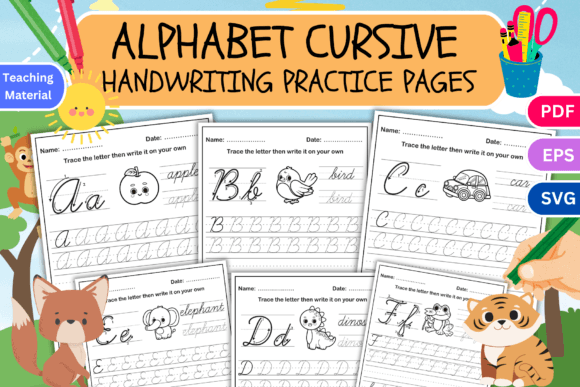
Each of the 26 pages follows a consistent, pedagogically grounded layout. At the top, the target letter appears in both uppercase and lowercase cursive forms, rendered with clear stroke-direction arrows. These arrows aren’t decorative—they reflect standard Zaner-Bloser or D’Nealian stroke sequences, helping learners internalize proper formation before muscle memory sets in. Beneath the models, generous lined space allows for repeated practice—enough for 5–8 guided attempts per letter without crowding. This repetition window is calibrated: too little fails to build fluency; too much invites fatigue or careless copying. Here, it strikes a practical balance.
Below the practice lines sits a small, line-art illustration (e.g., an “A” with an apple, a “G” with a giraffe) that begins with the target letter. The image is intentionally simple—designed for coloring, not complexity—so attention stays on the letter form and fine-motor control. It also serves a dual function: reinforcing letter-sound correspondence, which bridges handwriting practice with early literacy goals. Finally, two to three short cursive words containing the letter appear at the bottom (e.g., “ant,” “apple,” “all” for A). These aren’t random—they demonstrate common letter connections, spacing, and contextual usage, helping learners see how isolated strokes become functional writing.
File Format Flexibility for Creators and Educators
The delivery package includes a ready-to-print PDF (8.5 × 11 in, 300 DPI), plus individual SVG and EPS files—one per letter. This isn’t just convenience; it’s workflow utility. Educators can import SVGs into interactive whiteboard software or learning platforms like Seesaw or Google Slides for digital annotation. Curriculum designers and KDP publishers can embed EPS versions directly into interior layouts without raster degradation. Freelance illustrators or worksheet creators may repurpose the clean vector outlines for custom adaptations—say, adding themed backgrounds or adjusting line height for specific student needs—without sacrificing print fidelity.
That said, the license restricts resale of individual pages. This is standard—and appropriate—for resources built from original hand-drawn letterforms. What *is* permitted—and practically valuable—is integration into larger, value-added products: full-year handwriting workbooks, themed activity bundles (e.g., “Back-to-School Cursive Kit”), or supplemental sections within broader literacy guides. For KDP publishers, that means these pages serve reliably as high-quality, production-ready interior components—not standalone listings, but dependable building blocks.
Real-World Usability and Consistency
In classroom trials and homeschool settings, users report strong engagement retention across multiple sessions—particularly when paired with brief verbal modeling (“Start at the top, loop down, then up and around”). The consistent layout reduces cognitive load: children quickly learn where to look for the model, where to write, and where to find the connecting words. No reorientation is needed from page to page, which matters for young learners still developing visual scanning skills.
Print quality holds up well on standard office printers and copy machines. The 300 DPI resolution ensures crisp lines and arrow details even after several generations of photocopying—a real consideration in resource-limited schools. Vector files retain scalability, so resizing for large-format posters or digital zooming introduces no pixelation or stroke distortion. There’s no stylistic drift between letters: the lowercase “g” matches the flow and slant of the uppercase “G”; the “s” and “z” share proportional spacing logic. That consistency supports transfer—once a child grasps the rhythm of one letter group (e.g., “a,” “d,” “g”), related forms feel intuitive, not arbitrary.
Who Benefits—and How
Educators gain a low-prep, high-utility tool for whole-group warm-ups, small-group intervention, or independent station work. Because each page isolates one letter while embedding phonics and vocabulary, it fits naturally into balanced literacy blocks—not as an add-on, but as a reinforcing thread.
KDP authors and curriculum developers benefit from the professional-grade file suite. Rather than redrawing cursive models from scratch—or licensing inconsistent clipart—the set provides a unified, educationally sound foundation. When building a 96-page handwriting workbook, having 26 vetted, printable, vector-compatible pages cuts production time significantly. And because the illustrations are simple line art—not licensed characters or copyrighted themes—the risk of takedowns or compliance issues is minimal.
Homeschooling parents and tutors appreciate the clarity and scaffolding. There’s no ambiguity about where to start or how many repetitions are expected. The coloring element adds a tactile, calming layer—especially helpful for children who fidget or struggle with sustained focus. One parent noted using the “M” page alongside a muffin-baking activity: tracing the letter, coloring the muffin, then writing “mix,” “milk,” and “more” in cursive—turning abstract practice into concrete experience.
Practical Considerations and Limitations
This resource excels at its defined scope: structured, sequential cursive letter introduction and reinforcement. It does not include advanced features like joined-word drills beyond the initial examples, self-assessment checklists, or differentiated versions for left-handed writers (e.g., slant adjustments or right-side margin guidance). Those seeking comprehensive handwriting programs—including posture instruction, pencil grip diagrams, or multi-sensory techniques (e.g., sky-writing, sand trays)—will need to supplement.
It also assumes baseline fine-motor readiness. Children still mastering pencil control may find the line spacing tight or the stroke sequences fast-paced. In those cases, using the pages alongside manipulatives (e.g., forming letters with pipe cleaners or clay) or starting with gross-motor air-writing first yields better outcomes.
Finally, while the illustrations support letter-sound awareness, they don’t replace explicit phonics instruction. A child coloring the “Q” quail still needs support understanding that “qu” makes /kw/, not /k/. Used as part of a broader literacy strategy—not as a standalone solution—the Cursive Alphabet Handwriting Practice delivers measurable, repeatable value.
A Resource That Scales With Intention
What makes the Cursive Alphabet Handwriting Practice stand out isn’t flashiness or over-engineering—it’s alignment. It aligns visual design with motor development research, file utility with creator workflows, and pedagogical structure with classroom realities. For educators, it’s a reliable anchor in handwriting instruction. For publishers, it’s production-ready integrity. For parents, it’s clarity amid noise. It won’t replace teacher judgment or adapt automatically to every learner’s pace—but it gives all three audiences a consistent, high-fidelity starting point. And in skill-building work, especially with young hands and developing neural pathways, consistency isn’t just helpful. It’s essential.