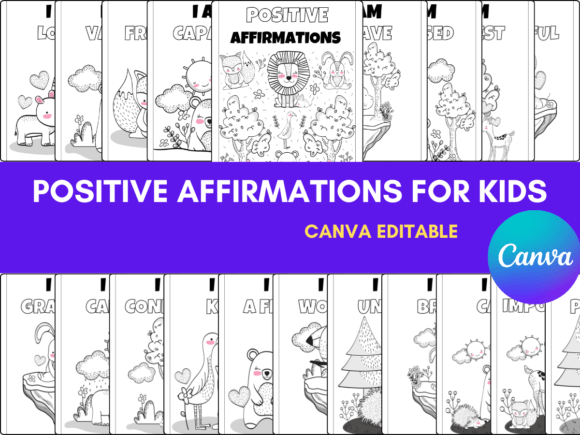
Affirmation Coloring Pages for Kids: Where Creative Expression Meets Emotional Development
Coloring is often dismissed as simple recreation—yet decades of child development research affirm its profound cognitive, emotional, and neurological value. When paired intentionally with language that shapes self-perception, coloring transforms into a quiet but potent developmental tool. Affirmation Coloring Pages for Kids represent this convergence: 23 thoughtfully crafted printable pages where illustration, typography, and psychology align to support young learners in building inner resilience, self-awareness, and emotional vocabulary.
How Affirmations Function in Early Childhood Development
Affirmations are not magical phrases—they’re linguistic scaffolds. In early childhood (ages 3–10), the brain exhibits high neuroplasticity, meaning repeated exposure to positive, present-tense statements—especially when paired with focused attention and sensory engagement—strengthens neural pathways associated with self-concept and emotional regulation. A statement like “I am kind to myself” doesn’t override complex feelings; instead, it offers a gentle, accessible counterpoint to emerging self-criticism or uncertainty. When children color while encountering such statements visually embedded in art, they anchor the idea not just cognitively, but kinesthetically and emotionally.
This dual-layered processing—fine motor movement + verbal reinforcement—is why Affirmation Coloring Pages for Kids differ from standalone posters or spoken affirmations. The act of choosing colors, staying within lines (or deliberately going beyond them), and returning to the same phrase across sessions builds familiarity and ownership. It’s not about memorization—it’s about internalization through repetition, choice, and creative agency.
Design Principles Behind the 23 Pages
Each of the 23 Affirmation Coloring Pages for Kids reflects evidence-informed design choices—not aesthetic preferences alone. Consider these intentional features:
- Line weight variation: Thicker outlines around central figures provide stability for developing hand control, while finer interior details invite exploration for older children or those seeking challenge.
- Strategic negative space: Ample blank areas reduce visual overwhelm—a critical accommodation for neurodivergent learners, including children with ADHD or sensory sensitivities.
- Thematic resonance: An affirmation like “I grow stronger every day” appears alongside a sprouting seedling, not a rocket ship. The imagery reinforces meaning without requiring explanation, supporting pre-literate and emergent readers alike.
- Typography integration: Affirmations are embedded as part of the illustration—not tacked on as captions. This encourages natural eye movement between image and text, reinforcing associative learning.
Themes span nature (forest friends, ocean life), imagination (cloud castles, star maps), daily routines (breakfast tables, bedtime rituals), and identity (mirrors, heart-shaped silhouettes). This diversity avoids over-indexing on any single cultural or gendered trope—allowing each child to find entry points aligned with their interests and lived experience.
Practical Applications Across Contexts
The versatility of these pages stems from their format—not just their content. Available in PDF (print-optimized), PNG (digital layering), and Canva-editable versions, they serve distinct functions depending on user needs and environment.
Educators and Therapists
In classrooms, counselors use individual pages as transition tools—handing a student “I can try again” before a challenging math task, or “My feelings matter” during morning check-ins. Small-group coloring circles foster nonverbal expression and peer modeling. For speech-language pathologists, the pages support articulation practice (“I am brave”) and narrative generation (“What does bravery look like in this picture?”).
Parents and Caregivers
At home, these pages replace screen time with grounded, low-stakes engagement. Unlike apps with algorithms designed to retain attention, coloring invites presence—not performance. A parent might place “I listen with my whole body” beside a child’s homework station, or bind several pages into a “feelings journal” where children add written reflections or stickers after coloring.
Content Creators and Entrepreneurs
The editable Canva files enable customization without design expertise—adding school logos, translating affirmations into bilingual formats, or adapting illustrations for specific therapeutic goals (e.g., trauma-informed versions with grounding symbols). KDP authors integrate them into activity books with reflection prompts; wellness coaches embed them in digital planners; Etsy sellers layer them with watercolor textures for premium printables.
Adult Learners and Self-Guided Practice
Though designed for kids, the principles apply broadly. Adults experiencing anxiety or burnout report benefit from using these pages as tactile mindfulness anchors—focusing on breath while filling in petals on “I am safe right now,” or tracing letters of “I trust my journey.” The absence of pressure to “do it right” makes them accessible where traditional journaling may feel daunting.
Why Format Flexibility Matters Beyond Convenience
The inclusion of multiple file types responds to real-world constraints—not marketing flair. PDFs preserve vector sharpness for crisp printing at any scale, essential for classroom reproducibility. PNGs allow educators to insert pages directly into Google Slides for hybrid learning or overlay calming animations in Seesaw. Canva access empowers users to adjust font size for visual impairments, swap affirmations for culturally relevant phrasing (“We belong here” instead of “I belong”), or isolate elements for AAC (Augmentative and Alternative Communication) boards.
This adaptability also supports ethical implementation. Rather than prescribing a single “correct” way to use the resource, the format options acknowledge that context dictates function: a rural teacher with limited ink may prioritize black-and-white PDFs; a telehealth therapist might animate a PNG sequence for virtual sessions; a Montessori guide may cut out and laminate individual affirmations for tactile sorting activities.
Supporting Holistic Skill Integration
While emotional growth is central, these pages inherently reinforce parallel competencies:
- Fine motor development: Controlled coloring strengthens finger isolation and wrist stability—foundational for handwriting and tool use.
- Executive function: Deciding color schemes, managing materials, and sustaining attention across a multi-step task build working memory and planning skills.
- Mindfulness practice: The rhythmic motion of coloring activates the parasympathetic nervous system, lowering cortisol and improving emotional availability.
- Vocabulary expansion: Terms like “resilience,” “gratitude,” and “curiosity” appear in context—not definitions—making abstract concepts tangible.
Crucially, none of these benefits require adult instruction. A child coloring “I wonder with joy” while sketching constellations isn’t “learning about curiosity”—they’re practicing it. The page becomes a mirror and a map simultaneously: reflecting who they are while inviting who they might become.
Considerations for Thoughtful Implementation
Even well-designed resources require contextual awareness. First, avoid treating affirmations as corrective tools—never pair “I am enough” with a child who’s struggling academically as if the statement negates their frustration. Instead, offer it alongside validation: “It’s okay to feel stuck—and you’re still enough, exactly as you are right now.”
Second, honor developmental readiness. A 4-year-old may point to the sun on “I shine brightly” and say “That’s me!”—a concrete, joyful connection. A 9-year-old might debate what “brightly” means socially or ethically. Both interpretations are valid; the page holds space for evolving understanding.
Third, observe usage patterns. If a child consistently chooses pages about safety or calm, it may signal unmet needs worth exploring gently—not correcting. The coloring page becomes diagnostic data, not just an activity.
Looking Beyond the Page
The true measure of these Affirmation Coloring Pages for Kids lies not in how many are printed, but in how deeply their messages echo beyond the paper. A child who colors “My voice matters” may later raise their hand in class without prompting. One who repeats “I can ask for help” may approach a teacher after weeks of silence. These shifts aren’t guaranteed—but they’re made more possible when positive self-concept isn’t abstract advice, but a repeated, sensory-rich experience woven into daily life.
Ultimately, these 23 pages function as quiet companions in development: neither prescriptive nor passive, but participatory. They don’t tell children who to be—they offer gentle, colorful invitations to notice, explore, and return—to themselves.