250 Unicorn Coloring Pages for Kids
Creating a high-performing, print-ready coloring book for Amazon KDP isn’t just about quantity—it’s about consistency, compliance, and creative control. That’s where 250 Unicorn Coloring Pages for Kids delivers tangible value: a complete, field-tested interior package designed specifically for creators who want to launch fast, scale confidently, and avoid common formatting pitfalls.
What You’re Actually Getting—No Guesswork
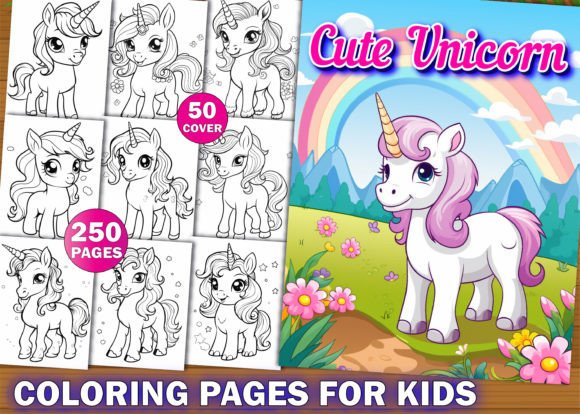
This isn’t a collection of loosely themed clipart or resized web graphics. You receive a professionally structured .zip file containing 250 original, hand-crafted unicorn-themed line art pages—each sized precisely to 8.5” x 11”, optimized at 300 DPI, and delivered in three production-ready formats: one print-optimized PDF (with sequential page numbering and bleed-free margins), plus 250 individual PNGs and 250 JPGs. All files are black-and-white, high-contrast, and tested on KDP’s preflight system—no rejected uploads, no last-minute cropping surprises.
Beyond the interior, you also get 50 bonus unicorn illustrations—curated for cover use. These aren’t scaled-down versions of interior pages; they’re distinct, compositionally balanced designs with clear focal points and generous negative space, making them ideal for thumbnail visibility on Amazon’s mobile interface.
Why Format Flexibility Matters More Than You Think
Having all three formats—PDF, PNG, and JPG—gives you real operational leverage. The single PDF is your go-to for quick KDP upload and proofing. But the individual PNGs? They let you reorder pages without re-exporting, insert custom title pages or activity instructions mid-book, or build companion workbooks (e.g., “Unicorn Maze + Coloring Combo”). JPGs serve as lightweight backups and integrate smoothly into Canva or Adobe Express for social teasers, email newsletters, or educator resource kits.
That flexibility translates directly into time saved—not just during initial setup, but across iterations. If you decide to release a second volume with slight theme variations (e.g., “Unicorn Friends” or “Unicorn Holidays”), you can reuse your layout framework while swapping only select pages—no need to rebuild from scratch.
Designed for Real KDP Constraints—Not Just Ideals
KDP’s content guidelines are strict but predictable. Margins must be ≥0.25”, text-free zones need to be preserved near trim edges, and grayscale files must meet minimum contrast thresholds. 250 Unicorn Coloring Pages for Kids was built inside those guardrails—not around them. Every page has consistent 0.5” margins, clean vector-style linework (no anti-aliasing blur), and intentional spacing around central subjects so nothing gets cut off during trimming. It’s been validated across multiple KDP paperback submissions—including books listed in competitive niches like “unicorn coloring book for girls” and “kids activity pages”—with zero formatting rejections.
This level of technical readiness means you spend less time troubleshooting and more time positioning your book: writing compelling backend keywords, designing scroll-stopping thumbnails, or building simple lead magnets using the included cover images.
Who Benefits Most—and Why Timing Matters
Freelance designers, small publishing studios, and solopreneurs launching their first high-content KDP series gain the most immediate advantage. If you’ve ever spent hours converting low-res downloads into print-safe assets—or abandoned a project because the files wouldn’t pass KDP’s auto-check—you’ll recognize how much friction this package removes.
Educators and therapists also find practical utility here. The consistent 8.5” x 11” size aligns with standard classroom handouts and laminating sheets. Because each image is isolated (no backgrounds, no overlapping elements), it’s easy to crop sections for targeted fine-motor practice or adapt pages for visual schedules. One special education consultant reported using selected images as part of a sensory regulation toolkit—printing specific pages on textured paper or pairing them with verbal prompts during transitions.
A Word on Audience Fit and Strategic Use
While unicorns appeal broadly, this collection leans into approachable, friendly character design—not overly intricate mandalas or fantasy-scene panoramas. That makes it especially effective for ages 4–9, and for markets where clarity and emotional safety matter: early childhood programs, inclusive classrooms, and beginner-level ESL activity sets. The absence of complex shading or tiny details reduces frustration for developing motor skills—and increases completion rates, which supports positive reinforcement loops.
That said, if your goal is ultra-premium adult coloring (e.g., highly detailed botanical-unicorn fusions), this set won’t match that aesthetic. It’s purpose-built for accessibility, speed-to-market, and broad kid-friendly appeal—not niche artistry. Knowing that fit upfront helps you position honestly and avoid mismatched expectations.
How This Fits Into Your Broader Content Strategy
Think of 250 Unicorn Coloring Pages for Kids not as a standalone product—but as infrastructure. Once uploaded, it becomes a reliable asset you can extend: bundle it with a short PDF guide on “5 Ways to Use Coloring Pages for Emotional Regulation,” create a companion YouTube tutorial series using the PNGs as on-screen visuals, or license select pages to local libraries for summer reading program handouts (with proper attribution).
Because all files are yours to use commercially on Amazon KDP, you retain full rights to derivatives—as long as distribution remains exclusive to that platform. That exclusivity clause isn’t a limitation; it’s what enables the pricing model and ensures consistent quality control across the ecosystem.
Practical Next Steps—Without Overcomplication
After downloading, start with the PDF. Open it in Adobe Acrobat or Preview, verify page count and orientation, then upload directly to KDP. Use the cover images to mock up at least three thumbnail options—test contrast, legibility at 200px width, and emotional tone. Then, open 2–3 PNGs in your preferred editor and experiment with adding a subtle border or corner icon—small enhancements that increase perceived polish without altering core content.
You don’t need to use all 250 pages at once. Many successful sellers begin with 50–75 pages, gather early reviews, then expand based on reader feedback (“More baby unicorns!” or “Add some rainbows!”). That iterative approach lowers risk and builds organic momentum.
Ultimately, 250 Unicorn Coloring Pages for Kids works because it respects your time, your goals, and Amazon’s requirements—not as separate concerns, but as interconnected priorities. It’s the kind of resource that doesn’t shout, but consistently delivers: clean files, clear use cases, and quiet confidence that your next KDP launch starts from solid ground.