2025 Stress Processing Journal for Canva: A Practical Evaluation for Planners and Self-Reflection Users
The 2025 Stress Processing Journal for Canva is a digital, editable planner designed specifically for adults seeking structured yet flexible tools to understand, track, and respond to stress—not just manage symptoms. Unlike generic daily planners or static PDF journals, this resource centers on cognitive and behavioral patterns tied to stress: identifying sources, mapping emotional responses, evaluating coping strategies, and integrating self-care into routine. It’s built for Canva, meaning users can personalize colors, fonts, layouts, and content without design expertise—making it accessible to beginners while retaining depth for those with more experience in journaling or mental wellness practices.
What Sets This Template Apart from Other Planner Options
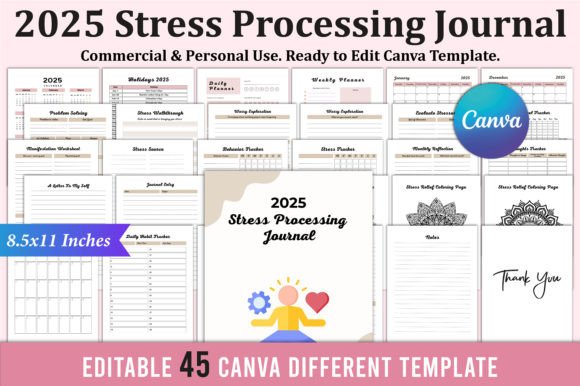
Most printable planners focus on time management or habit tracking. The 2025 Stress Processing Journal for Canva diverges by organizing its 45 pages around psychological scaffolding—pages like Worry Exploration, Stress Walkthrough, and Evaluate Stressors invite reflection before action. These aren’t prompts that ask “How stressed are you today?” but rather “What triggered that feeling? What assumptions were present? What did your body do?” That distinction matters for users aiming to build long-term resilience, not just short-term relief.
Its Canva-native format also supports iterative use. Because each page is individually editable—and includes CMYK color profiles and 300 DPI resolution—it’s suitable both for screen-based journaling and high-fidelity printing. This bridges a common gap: many digital journals sacrifice print quality, while print-first templates lack adaptability. The inclusion of Stress Relief Coloring Pages, Self-Care Calendar, and A Letter To Myself further signals intentionality—not just about logging, but about creating space for compassion and creativity.
Comparing Formats: Canva Templates vs. Static Printables vs. App-Based Tools
When evaluating planning resources, format shapes function. Static PDFs (often sold on Etsy or KDP) offer simplicity and immediate use—but editing requires Adobe Acrobat or similar software, and personalization is limited to handwritten notes or basic text fields. The 2025 Stress Processing Journal for Canva avoids that constraint: users change headers, rearrange sections, or add new pages directly in Canva’s interface—even on mobile. That flexibility supports evolving needs across the year.
App-based alternatives (like Day One or Reflectly) provide reminders, cloud sync, and searchability—but they often lack the tactile grounding and visual customization that many users rely on for reflective work. They also raise privacy considerations when journaling about sensitive topics like stress sources or emotional patterns. A Canva-based journal keeps data local unless intentionally shared, and allows full ownership of the file—no subscriptions or algorithm-driven nudges.
That said, Canva does require internet access and a free account. Users who prefer offline, pen-and-paper journaling without any digital layer may find even an editable template less aligned with their rhythm. In those cases, a well-designed static printable—especially one with similar psychological framing—could serve equally well, provided the user values consistency over customization.
Strengths and Realistic Tradeoffs
One strength of the 2025 Stress Processing Journal for Canva lies in its thematic coherence. Pages don’t feel randomly assembled; instead, they scaffold insight over time. For example, the Stress Level Tracker and Behavior Tracker feed into the Monthly Reflection, which then informs the Problem Solving and Manifestation Worksheet pages. This progression mirrors evidence-informed approaches like cognitive behavioral journaling, where awareness precedes intervention.
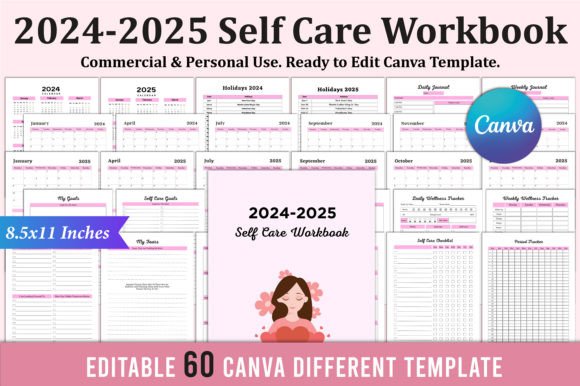
Another advantage is scalability. With 45 distinct pages—including variations like three unique Stress Relief Coloring Pages and two Worry Exploration layouts—users can rotate content based on current needs. Someone navigating a high-pressure work quarter might lean into Stress Source and Thoughts Tracker daily, while shifting to Daily Gratitude and Self-Care Calendar during recovery phases.
Tradeoffs exist, too. Because it’s built for Canva, there’s no auto-saving across devices unless users manually save versions or use Canva’s version history. There’s also no built-in analytics—unlike apps that generate charts from mood logs. And while the design is original and high-resolution, users wanting deep integrations (e.g., syncing with Google Calendar or Apple Health) will need to bridge those manually.
Best-Fit Scenarios: When This Journal Fits—and When It Might Not
This resource fits well for adults aged 20–50 who:
- Prefer visual, customizable tools but aren’t designers;
- Want structure without rigidity—pages that guide reflection without prescribing answers;
- Are exploring stress patterns over months, not just days;
- Value both digital convenience and print-ready output;
- Use journaling as part of broader self-development—not just symptom tracking.
It’s especially relevant for educators, healthcare workers, freelancers, or caregivers whose stressors are relational, unpredictable, or emotionally complex. A teacher might use Stress Walkthrough after a challenging parent meeting; a caregiver could revisit A Letter To Myself during moments of emotional depletion.
Conversely, it may be less ideal for users who:
- Need voice-to-text input or speech-based journaling;
- Prefer minimalism—some pages include layered prompts and sidebars that may feel dense at first glance;
- Require accessibility features like screen reader compatibility (Canva’s editor has growing support, but isn’t fully optimized for all assistive tech);
- Seek community features, guided audio, or therapist-moderated content.
Practical Use Tips for Getting the Most From This Resource
Start small. Rather than filling every page daily, choose one or two that align with your current focus—for instance, Daily Journal paired with Stress Level Tracker. After two weeks, review entries using the Monthly Reflection page to spot patterns: Are certain days, people, or tasks consistently linked to higher stress levels? Does your Self-Care Calendar reflect actual behavior—or intention?
Use the editable nature intentionally. If “gratitude” feels stale, rename Daily Gratitude to Three Anchors and adjust the prompt. If the Behavior Tracker feels too broad, duplicate the page and narrow it to one habit—like “moments I paused before reacting.” Canva makes that easy; the value comes from tailoring, not following rigidly.
Finally, treat the Thank You Page not as an endpoint, but as a checkpoint. Revisit it mid-year. What’s shifted? What still feels unresolved? That kind of meta-awareness—supported by consistent, adaptable structure—is where the 2025 Stress Processing Journal for Canva delivers tangible, non-commercial value.
Making an Informed Choice
There’s no universal “best” journal—only what fits your process, priorities, and pace. The 2025 Stress Processing Journal for Canva stands out for its blend of psychological grounding, practical flexibility, and accessible design. It doesn’t promise transformation, but it does offer thoughtful architecture for it. Whether you’re comparing options, testing alternatives, or refining your existing system, clarity about your goals—awareness, action, integration, or release—will guide the most useful choice. And sometimes, the right tool isn’t the flashiest one, but the one that quietly meets you where you are.