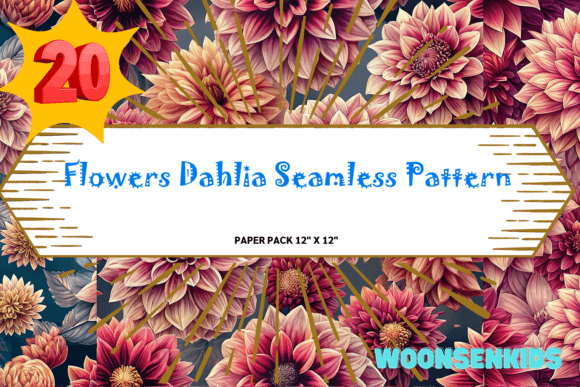
20 Flowers Dahlia Seamless
The 20 Flowers Dahlia Seamless is a curated digital pattern pack containing 20 high-resolution, watercolor-style seamless designs featuring dahlia flowers. Each pattern is delivered as a standalone PNG file, sized at 12″ × 12″ (3600 × 3600 pixels) and rendered at 300 DPI—meeting standard print and digital publishing requirements. The collection emphasizes organic texture, soft blending, and natural color variation typical of hand-painted watercolor, with intentional repetition points that allow for tile-based use across surfaces without visible seams.
Who Might Consider This Collection?
This set appeals to creators who need ready-to-use, aesthetically cohesive floral patterns for projects where visual consistency and artisanal quality matter. It is especially relevant for designers working on KDP (Kindle Direct Publishing) interiors or covers, small-batch stationery producers, crafters developing printable planners or greeting cards, and digital artists sourcing textured backgrounds for web or desktop use. Because the files are pre-formatted and optimized, users seeking efficiency—without sacrificing design integrity—may find this collection practical.
Key Benefits
- Ready-to-deploy format: All 20 PNG files are sized and resolution-optimized for immediate use in KDP templates, print-on-demand services, or digital layouts—no resizing or tiling adjustments needed.
- Consistent aesthetic: The unified watercolor style ensures visual harmony across multiple applications, reducing time spent matching tones or textures from disparate sources.
- Seamless tiling capability: Each pattern repeats cleanly, supporting scalable background use for large-format prints, website headers, or fabric mockups.
- Transparent background support: As PNGs, the files retain transparency, allowing flexible layering over colors, photos, or other design elements.
Tradeoffs and Considerations
While the 20 Flowers Dahlia Seamless offers convenience and stylistic cohesion, it does not include editable vector files (e.g., SVG or AI), layered PSDs, or source watercolor brush sets. Users needing to recolor individual petals, adjust contrast per element, or isolate specific blooms will be limited by the flattened raster format. Additionally, because the patterns are pre-tiled and fixed in scale, fine-tuning repeat density or altering motif spacing isn’t possible without external editing tools.
Color fidelity may vary slightly across devices and printers due to differences in color profiles and paper stock—especially noticeable in subtle watercolor gradients. Previewing test prints or soft-proofing in CMYK before bulk production is advisable. Also, while the collection features 20 distinct arrangements, the underlying botanical motif remains exclusively dahlia-focused; users seeking broader floral variety (e.g., mixing roses, peonies, or wildflowers) would need supplementary assets.
Situations Where This Collection Is a Strong Fit
The 20 Flowers Dahlia Seamless works well when your project goals emphasize speed, thematic unity, and tactile visual warmth. For example:
- You’re designing a series of KDP journals or coloring books and need coordinated, non-repetitive yet harmonious interior page backgrounds.
- You produce physical greeting cards or gift tags and want consistent, premium-feeling floral motifs across product lines without commissioning custom illustrations.
- You’re building a brand identity centered on botanical elegance and require versatile, licensable patterns for social media banners, email headers, and printed packaging.
- You’re new to pattern design and prefer learning through application rather than creation—using these files as references for layout, cropping, and scaling decisions.
When Alternatives May Be Worth Evaluating
Consider other options if your workflow requires flexibility beyond static raster tiles. For instance:
- Vector-based dahlia patterns (e.g., EPS or SVG) offer infinite scalability and full color/edit control—ideal for logo integration or large-format signage where pixelation must be avoided.
- Modular design kits—which include isolated dahlia elements, stems, leaves, and scatter brushes—support custom composition and adaptive layouts, particularly useful for book cover illustration or editorial design.
- Subscription-based pattern libraries provide rotating seasonal collections and broader botanical diversity, better suited for businesses needing ongoing visual refreshes without repeated purchases.
- Custom illustration commissions ensure complete originality and alignment with specific brand guidelines—valuable when uniqueness and legal exclusivity are priorities.
Making an Informed Decision
Before choosing the 20 Flowers Dahlia Seamless, clarify your primary use case. Ask yourself:
- Do you need 20 distinct but thematically aligned patterns—or would fewer, more adaptable assets serve you longer?
- Is seamless tiling essential, or do you primarily use full-bleed, non-repeating backgrounds?
- Will your output be predominantly digital (e.g., web, e-book), or do you anticipate frequent physical printing where paper type and ink absorption affect watercolor subtlety?
- Do you already have access to design software capable of adjusting opacity, blending modes, or basic color correction—or do you rely entirely on out-of-the-box usability?
If your answers point toward efficiency, thematic consistency, and KDP- or craft-oriented applications, this collection aligns well with those needs. If instead you prioritize adaptability, scalability, or long-term asset ownership across evolving projects, exploring vector alternatives or modular kits may yield greater return on investment.
Final Thoughts
The 20 Flowers Dahlia Seamless is a purpose-built resource—not a universal solution, but a targeted tool. Its value lies in its specificity: 20 thoughtfully composed, watercolor-rendered dahlia patterns, delivered in a standardized, production-ready format. For users whose creative goals center on cohesive, warm, and naturally textured outcomes—particularly within KDP, stationery, or digital background contexts—it provides tangible utility. As with any digital asset, evaluating fit against your technical capacity, intended outputs, and long-term design strategy remains essential to making a practical, sustainable choice.